Showing posts with label Tram. Show all posts

Monday, October 14, 2013

Monument Mondays: Tomb of Eurysaces

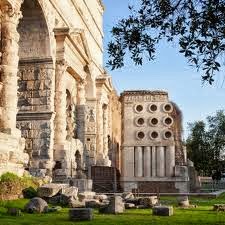
Have you ever wondered what those big marble holes in Porta Maggiore were?


Today we are going back in history to check out one of Roma's most interesting monuments.

Ancient Roma was full of slaves. Many were former artisans that were seized with Roma's expansion into new territories, while others were born into servitude. While slaves were usually treated better than the name connotes, they lacked many rights that Romans enjoyed. One such right was the privilege to be remembered through history by sculpture. For Romans, this was the ultimate goal. A Roman citizen would take great pride in the busts of his ancestors, and typically display them throughout his house. When a person died, their entire "family" would be present at the funeral, with a procession of busts accompanying the wake.


Liberated slaves were called freedmen, and they usually possessed lucrative skills from their former lives as Roma's laborers, domestic help, artists, physicians, and even accountants. Freedmen often became incredibly wealthy, and their new status as a legitimate citizen allowed them to commission sculpture to be remembered forever. This could range from a simple funerary urn to a grand mausoleum, and are considered to be a vital part of today's ancient Roman sculpture studies. Upon  the gift of freedom, a freedman would take the last name of his/her former master, one was something that slaves never had the right to have in the ancient world.

The tomb of Marcus Vergilius Eurysaces is one of the largest and best preserved examples of any funerary monument in Roma. Eurysaces was a baker, and after he obtained freedom with his wife, he became an extremely successful selling bread to the Roman masses. He built this tomb for himself at the end of the Republic, around 50-20 BCE. The most interesting part about the monument is it's beautiful frieze, which depicts the entire bread baking process from picking the grain to distributing the fresh loaves. Roma had a very low literacy rate, and so sculpture was used as a tool to spread information to the public. Those big holes are probably depictions of kneading machines or grain storage vessels.


It was illegal for Romans to be buried inside the city walls, so the best real estate for funerary monuments was located on Roma's major roads leading into the city. This meant that every visitor that passed through Roma would see the accomplishments of the freedman, promising him eternal recognition. 

The tomb of Eurysaces is located in front of the ancient gates of Porta Maggiore, where tens of thousands of Romani see his monument every day. You can take a step back in time (although this time to 1973) to see this monument with TramTracks! We meet on the other side of the walls inside the city, but be sure to stop by and pay your respects to this incredible treasure.

Thursday, October 3, 2013

Event of the Week: Sagra dell'Uva Wine Festival!

This weekend there is a very special event for anyone interested in local wines and food. The Sagra dell'uva Festival in Marino takes place every year on the first Sunday of October. This year marks the 89th annual celebration, and it will be a great chance to see the beautiful towns of Castelli Romani, located just outside of Roma.


The Castelli Romani area used to have several volcanoes, which eventually formed crater lakes, now named Nemi and Albano. Wealthy Romans settled in the region because of it's refreshing summer temperatures, and later, Castel Gandolfo became the official summer residence of the Pope. 


Today, the region is known for it's wine and porchetta. The grapes grow high in the Alban Hills, and benefit from the volcanic soil in the area. In 1996, the Castelli Romani region was authorized to produce special DOC protected wines, assuring an authentic and unique product you can't find anywhere else. One well known white wine originating from the area is Frascati, which has been produced in the area for thousands of years and is Roma's signature wine. Even Pope Gregory XVI mentioned that it was his personal favorite! There are several varieties to choose from, including dry, sparkling or sweet, but make sure the top of the bottle has a the DOC quality seal. During the festival however, most people drink Marino DOC wine, which is slightly different from Frascati because it has more flavor. While Frascati is permitted to be made up entirely of the Trebbiano variety of grapes, which have less flavor, Marino caps Trebbiano at 25% to 55% of the blend.


Porchetta is a delicious local specialty originating from Ariccia (another town close to Marino). You can read more about it here. If you are a fan of pork, be sure to pick up a porchetta panino from one of the local vendors during the festival. It will pair great with the white wines from the event. 


To get yourself in the mood for this wonderful celebration, listen to a lovely song by Franco Silvestri, Na gita a li Castelli, which translates to "A Trip to the Castelli (Castles)". The song is also known as Nanni. It was written in 1926, a year after the first Festa di Sagra dell'uva. It has been performed by a number of well-known Italian performers, including this version by Alvaro Amici:


In the song he mentions that in the fountains of Marino wine flows instead of water:


You see here in Marino
there is the Festival of Grapes
fountains that give wine
how abundant there! 

Lo vedi ecco Marino
la Sagra c'è dell'Uva
fontane che danno vino
quant'abbondanza c'è!

This actually exists. It's called "il miracolo delle fontane che danno vino", which means "the miracle of the fountain that gives wine". Every year, for one hour, the town of Marino has wine flow out of it's central fountain instead of water to pay tribute to the history of the festival. In the 16th century, General Marcantonio Colonna was named the Lord of Marino after his success in the Battle of Lepanto, and the people of Marino honored him in a huge feast. 


The festivities start around 12:30 pm, when a variety of wine and food tastings will be given at Piazza San Barnaba. After some historical re-enactments of the victory parade of Marcantonio Colonna, il Miracolo (the Miracle) will begin from the Piazza San Barnaba's Fontana del Tritone at 5:30pm. Kegs will be gathered around the fountain and organizers will be distributing the famous wine. The festival continue into the evening.

If you happen to miss Sunday's events, il Miracolo also happens on 6pm, Monday evening.

The easiest way to get to the event is by train. From Termini Station, take the FL4 train for Marino. The train takes less than an hour, and drops you right into the action. Tickets are only a few euros, and the festival will surely be the highlight of your weekend! We serve some Castelli Romani wines on TramTracks too, so hop on and taste Roma's favorite wine for yourself.


Monday, September 30, 2013

Rocking the Colosseo


Everyone knows at if you are going to visit Roma, the Colosseo is a must-see. It’s a masterpiece of ancient technology, having endured 2,000 years of earthquakes, pilfering, fires and violently spectacular Roman entertainment. But did you know that in the past decade, the Colosseo has hosted a number of concerts by some of the world’s top musicians?
It started in 2002, when Ray Charles and other international artists came together to perform at Time for Life, a concert held during a multi-day global peace conference in Roma. The blues star hosted the event, and sang “Georgia on My Mind” in a brilliant gold sequined jacket.
In 2004 Simon & Garfunkel and the Everly Brothers rocked out in front of more than 500,000 spectators on the Via dei Fori Romani, rivaling their famous Central Park show that became one of the largest concerts in history.
Elton John used the Colosseo as the backdrop for a classic piano performance in 2005. The audience rocked along to favorites like Tiny Dancer and Bennie and the Jets under the blue and gold light of the Colosseo's illuminated arches.


In 2006, it was Billy Joel and Bryan Adams. As in years past, an estimated half a million people were in attendance, and giant viewing screens had to be set up along Via dei Fori Imperiali to improve the view for all to see.

In 2003, Sir Paul McCartney played an intimate acoustic set inside the Colosseo for charity and to raise money to maintain Rome’s historic sites. Tickets were restricted to just 400 lucky fans, each paying up to €1,295 for the once-in-a-lifetime opportunity. The next evening, armed with his classic left-handed Hofner Bass, McCartney performed another legendary (and free) set for 500,000 Romans and visitors in front of the ancient battle arena. He even played a special version of Domenico Modugno’s iconic Italian classic, “Il blu e dipinto di blu” also known as “Volare”!

It looks as though organizers have discontinued the concerts, but fortunately anyone can catch the beauty of the Colosseo in the Eternal City! There are so many ways to see this magnificent structure, with each vista and time of day offering a new perspective on the structure’s architectural beauty. Get out and explore the city, and hop on TramTracks to catch a view of the Colosseo like you've never seen it before!